How to share season tickets with friends
Splitting a package is easy to agree to and hard to do fairly. Everyone wants the rivalry game and the Saturday matinee, nobody wants the Tuesday in February, and the group chat turns into a negotiation. A draft turns that negotiation into a few clear steps.
1. Decide who is in before you decide who gets what
Settle the group first: who is buying in, and how many seats each person is responsible for. Money is a separate conversation from the draft, so agree on it before anyone picks. Once people have a favorite game in mind, it is much harder to talk about cost objectively.
2. List every game in one place
Write down each game or event in the package with its date, time and opponent. A single shared list means everyone is choosing from the same facts instead of from memory. In Top Salty Picks you add events one at a time or upload a CSV, so a full schedule takes a couple of minutes.
3. Pick the rules while nobody has a stake
The two rules that matter most are the order people pick in and whether that order reverses each round. Decide them before picking starts. Our guides on setting a fair pick order and on snake versus repeat drafts cover the trade-offs.
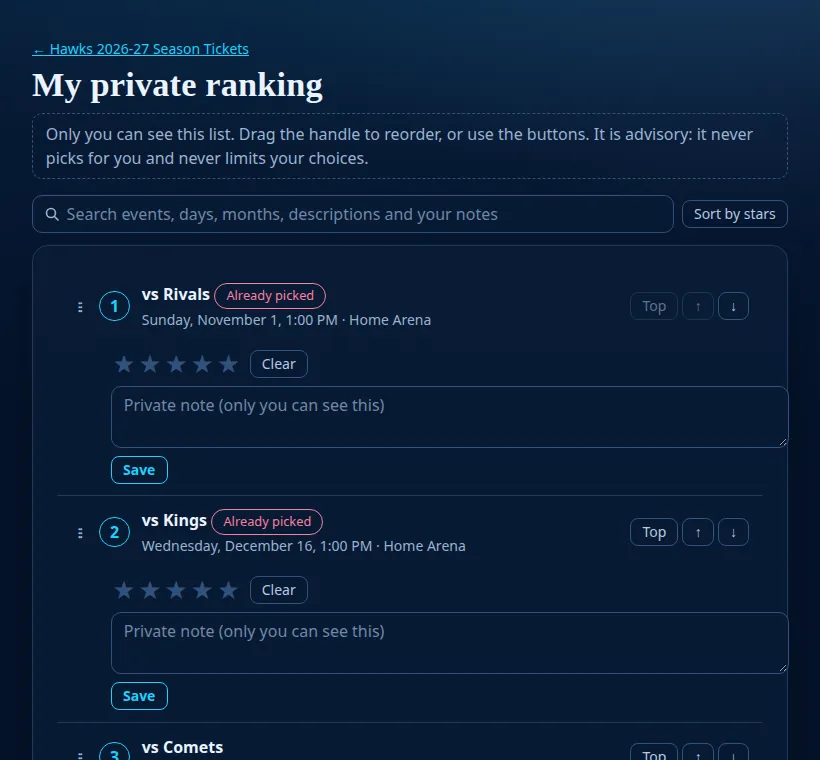
4. Let people rank their favorites before the draft
Real drafts stall when people are asked to choose on the spot. If each person can line up the games they want ahead of time, their turn takes seconds. Keep those rankings private so nobody picks around someone else’s list. In Top Salty Picks your ranking is visible only to you and never locks in a pick.
5. Pick in turn and keep a record
One person picks at a time, and everyone can see what has been taken. A written record of who chose what ends the “I thought I had that one” conversation later in the season.
Common problems
- One person always gets first choice. Reverse the order each round so the last pick of one round opens the next.
- People are slow to respond. Notifications on each turn help; email and text alerts tell the next person it is their turn.
- Plans change. Agree up front how swaps or giveaways will work. The draft decides the starting allocation, not every future trade.